


DataApex: Clarity Photodiode Array Extension (PDA)
Clarity is a chromatography data software for data acquisition, processing, and instrument control in regulated environment.


Description
The PDA Extension is an optional Extension that is used for processing data that has been acquired from selected photo diode array detectors. Spectral data, together with chromatograms, add a third dimension to analytical data analysis. This extension expands the capability of Clarity by providing interactive spectral analysis, peak purity analysis and compound identification that is based on a spectral library search. PDA data can be displayed in a set of optional views including 3D rendering.
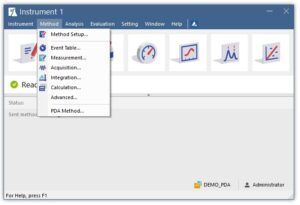
All data is saved in a single file; a chromatogram at any wavelength or even only a spectrum can simply be recalled for review after an analysis. UV-VIS spectra, acquired using a PDA detector, may be interactively selected from a chromatogram signal for visual inspection and comparison. The spectra may also be used for peak purity determinations, wavelength optimization and component identification through spectral libraries.
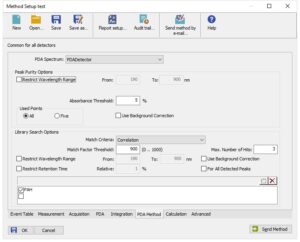
23.04.2018 , 11:17:38
Method Setup test
PDA View
The PDA view is customizable; up to four views can be displayed at one time (Any combination from the following views may be selected: Isoplot, Chromatogram, Spectra, 3D Display, Peak Purity, Peak Purity Spectra, Library Spectra Search and Spectral Library). The user can easily extract chromatographic signals from PDA data to determine the optimal detection wavelength for each peak.
PDA Method
The Clarity PDA method includes an option for Spectral Library Search and Peak Purity analysis..
Limit Values
These calculated values are compared to user-set limit values, either for each chromatogram separately or together for the selected series. Deviation of a certain parameter from the permissible limits is immediately reported and may lead to the termination of the sequence in progress.
Spectral Library
The Clarity software compares the peak spectra with the spectra of an unlimited number of spectral libraries. Spectra stored in a Spectral Library include retention times and analysis parameters (optional). The Spectral Library Search can perform automatic identification of integrated/calibrated components (peaks). The library search may be constrained by the RT Window and by Wavelength Range. Either the Least Square, the Weighted Least Square or the Correlation Method is used for calculating library search matches. A Background Correction option is also available.
Peak Purity
This analysis helps to discover hidden impurities. Peak Purity test is applied to all integrated/calibrated peaks in the active signal. Purity is calculated from 5 or all spectra within the peak. The similarity curve is displayed in the PDA window. Peak Purity analysis can be optimized by setting custom preferences relating to the purity threshold, wavelength restriction and absorbance threshold.
Import/Export Data
Spectral data can be imported/exported in ASCII text formats to or from the Clarity software.
Reports
Users can easily include PDA options such as data 3D Display, Isoplot, Spectra, Peak Purity and Library Search results in reports using the intuitive Report Setup Dialog.
Instrument Control
Control modules for Agilent 1100 DAD and FLD, Sykam S3210/3240, Knauer PDA and many others are available. Additional control modules for other PDA detectors can be developed upon request.
The following figures display typical configurations of Clarity chromatography station. Each configuration is described in details including the ordering numbers of utilized parts for easier reference.

The HPLC measures on two detectors. Clarity will acquire two separate signals sharing a common timebase (synchronized START/STOP). A resulting chromatogram will contain two signals.Part numbers: C50 (Clarity Chromatography SW, Single Instrument) + U32 (Colibrick USB dual-channel A/D converter).
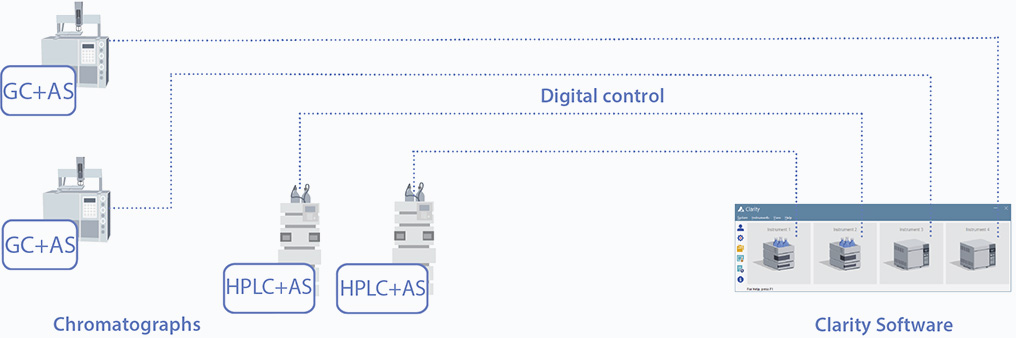
Clarity is used to acquire data from four chromatographs. Each chromatograph uses single detector, so it is enough to use four channel card. However it is necessary to purchase Clarity Ad-on instruments to be able to acquire data from four separate systems simultaneously. In this case the signals are completely independent.Part numbers: C50 (Clarity Chromatography SW, Single Instrument) +3x C55 (Clarity Add-on Instrument SW) + U34 (Colibrick USB 4-channel A/D converter).

This example displays a configuration with two chromatography systems (GC + HPLC) where the HPLC system uses multiple detectors. All the detectors attached to the HPLC Instrument will share common timebase (synchronized START/STOP). The GC detector will be independent.Part numbers: C50 (Clarity Chromatography SW, Single Instrument) + C55 (Clarity Add-on Instrument SW) + U34 (Colibrick USB 4-channel A/D converter).

This example displays a configuration with two chromatography systems (GC + LC). The GC is connected and controlled via digital interface, using a GC Control appropriate module.Part numbers: C50 (Clarity Chromatography SW, Single Instrument) + C55 (Clarity Add-on Instrument SW) +A23 (GC Control SW)+ U32 (Colibrick USB dual-channel A/D converter).
Related products

Couldn't find the product you were looking for?
We have an ever-increasing range of products, so we may just have it in stock already. If we don't, there is a good chance we can source it for you.
